
Direct answer
Unlimited website subscription or scoped monthly partner?
Unlimited request subscriptions suit a steady flow of small, separate tasks your team can queue and check. A scoped monthly Webflow partner suits connected work that needs prioritizing against goals and one person accountable for the whole site.
Any information contained on this Website is not legal advice and should not be treated as such. You should always contact an attorney for help with your specific legal needs and issues. We may also earn a commission when you click links to our partners and purchase goods or services. For more information, read our Disclaimers Policy.
Unlimited website request subscriptions work best for a steady flow of small, separate tasks that someone on your team can queue and check. A scoped monthly Webflow partner works better when requests connect to each other, need to be prioritized against goals, and need someone accountable for the whole site. For most marketing teams that run campaigns through the website, the second model fits better, although the first can be right for simple, high-volume design and edit work.
Here's how each model works, where each one shines, and the questions to ask before you sign up for either.
How unlimited request subscriptions work
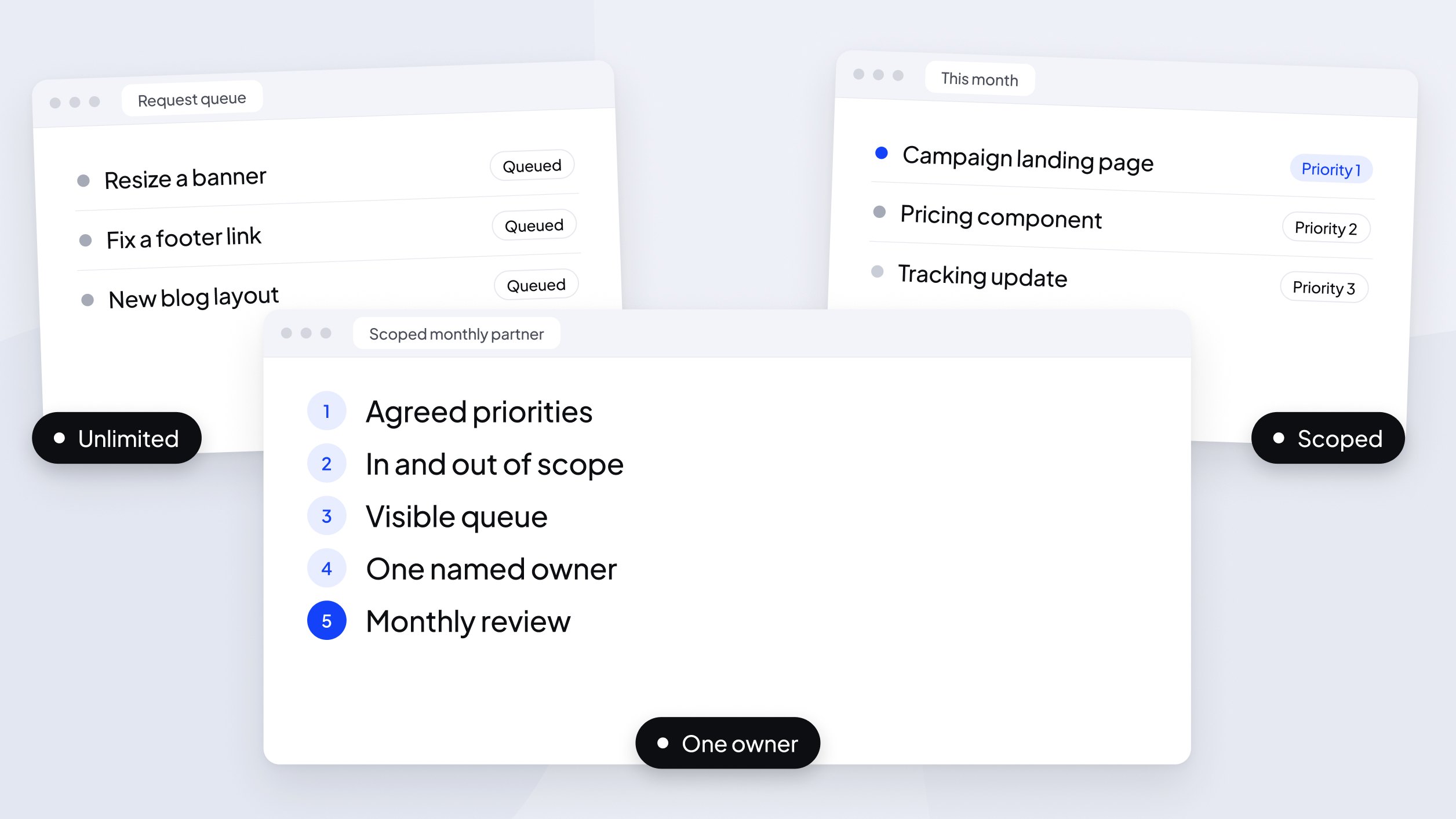
You pay a flat monthly fee and submit as many requests as you like. Requests go into a queue, and the provider works through them in order, usually with a limit on how many are active at once. "Unlimited" describes the number of requests you can submit, not how many get done at the same time.
The model is easy to buy and easy to understand. It suits work where each request stands alone: resizing graphics, small copy edits, a new blog layout, a quick page tweak.
How a scoped monthly partner works
A scoped partner agrees on a cadence and a set of priorities with you each month. The work is sized to your real queue, with clear boundaries for what's in scope and what isn't. When priorities change mid-month, the trade-off is discussed openly: something moves up, something else moves out.
The model suits work where requests depend on each other: a campaign that needs a landing page, a new component, a CMS field and a tracking update, all consistent with the rest of the site. One named owner keeps the whole site in view and reports on it each month.
How they compare
- Throughput. Subscriptions are fast for small, separate tasks. Scoped partners plan larger, connected work across weeks.
- Prioritization. In a subscription, you manage the queue order. With a scoped partner, priorities are agreed together against your goals.
- Consistency. A subscription team handles requests one by one, which can lead to small inconsistencies over time. A scoped partner works inside your component system and checks new work against it.
- Accountability. A subscription is accountable for each request. A scoped partner is accountable for the site as a whole, including what nobody asked for yet.
- Reporting. Subscriptions usually show a task board. Scoped partners usually add a monthly review of what changed and what needs a decision.
- Flexibility. Both are typically month to month. Subscriptions are easier to pause; scoped partners carry more context forward.
When an unlimited subscription is the right choice
- Your requests are small and independent.
- Someone on your team has time to write briefs, order the queue and review every delivery.
- Your site is simple, or a strong design system already exists and the requests stay inside it.
When a scoped partner is the right choice
- The website is a main marketing channel and campaigns depend on it.
- Requests involve components, CMS structure, integrations, SEO or QA, not just visuals.
- Nobody on your team owns the site, and you want one person who does.
- You care about the site staying consistent as more people and tools publish to it. Here's how drift builds up when they do.
Questions to ask either provider
- How many requests are worked on at once, and how long does a typical page take?
- Who decides the order of the queue?
- Who checks new work against our existing components and brand rules?
- Is the work done inside our Webflow site and accounts, or handed over afterwards?
- What's out of scope, and what happens when we need it?
- What do we get each month besides finished tasks?
- What documentation do we keep if we leave?
Where we fit
We're a scoped monthly partner, not an unlimited subscription. Each month runs on agreed priorities, a visible queue, and clear in-scope and out-of-scope boundaries, with one named owner and a monthly review. That's a deliberate choice: most marketing website work is connected, and connected work goes better when someone plans it.
Frequently asked questions
Is unlimited really unlimited?
You can submit unlimited requests. How many are worked on at once is usually limited, so delivery speed depends on queue length and request size.
Can a subscription handle Webflow development?
Some can, especially page builds inside an existing system. Ask who maintains the components and CMS structure, and who checks that new pages follow them.
Which is easier to leave?
Both are usually easy to cancel. What makes leaving easy is documentation and accounts in your name, so ask about both up front.
Next step
If your website work is connected and you want one owner for it, see how our monthly partnership works or Start a project.
When the fix becomes system work
We build Webflow sites and keep them running month to month, with one named owner for your site.
Start a project