
Direct answer
What is website drift?
Website drift is the slow gap between the site you launched and the one visitors see today, caused by many small changes that each made sense on their own. A monthly review that checks the live site against your written rules catches it early.
Any information contained on this Website is not legal advice and should not be treated as such. You should always contact an attorney for help with your specific legal needs and issues. We may also earn a commission when you click links to our partners and purchase goods or services. For more information, read our Disclaimers Policy.
Every change to your website made sense on the day it shipped. A contributor added a CMS item, a landing page went up for a campaign, a headline got sharper. The problem is the accumulation, and nobody sees it because everyone sees only their own change.
That slow divergence is website drift. This post covers what it looks like, why it’s speeding up, and how a monthly review catches it.
What drift looks like
Drift rarely arrives as one big mistake. It shows up as small contradictions:
- A blog post published last month quotes a price that the pricing page no longer shows.
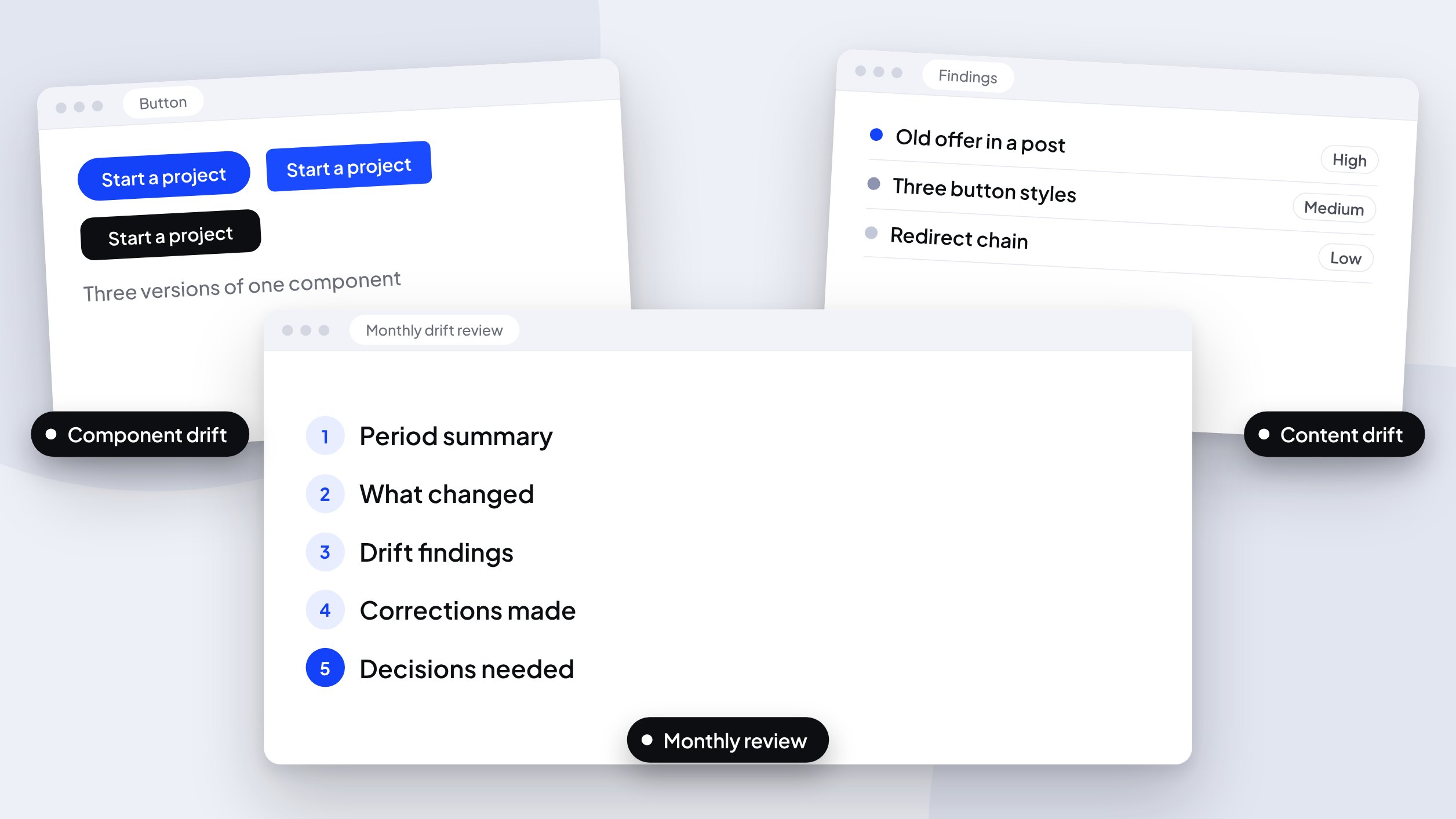
- Three versions of the same component exist, each used on different pages.
- A landing page built for last quarter’s positioning still ranks and still sends visitors to an offer you stopped selling.
- Instructions written for your team’s AI tools in March describe a product that has since been renamed.
- A redirect chain grows by one hop each time a URL gets renamed.
Each item is minor. Together they make a site that says several things at once.
Why it’s speeding up
More people and tools touch the site than before. In July 2026, Webflow reported that over 30% of its enterprise customers actively use its MCP server, with usage up more than four times since January. That server is the connection that lets AI tools such as Claude work on a site directly. The figure describes enterprise accounts, and many marketing teams haven’t reached that point yet.
The pattern holds at any size, though. More contributors, more tools, and more changes land in the same week, and nobody reads the whole site end to end.
What the tooling covers, and what it doesn’t
Platforms are adding guardrails. The same announcement describes branches for staging work, role-based permissions, reusable instructions that encode brand rules, and an activity log that attributes each change to a person or an AI. These answer an important question: who changed this, and were they allowed to?
They don’t answer a different one: does the site still say one coherent thing? That takes someone reading the site against the rules, on a schedule, with the authority to flag what needs a decision.
Two kinds of drift
A useful review separates two problems that look the same:
- Content that breaks a rule that’s still correct. A CMS item uses language your messaging framework rules out. The fix is to correct the content.
- A rule that has gone stale. The framework still describes last year’s offer. The fix is to update the rule, and that’s a decision for whoever owns positioning.
Mix them up and a review makes things worse: good content gets rewritten to match an outdated rule.
A monthly review that fits on one page
A drift review works best as a short, consistent report with five parts:
- Period summary. Requests received, shipped, held, and why.
- What changed. What changed on the site, and who or what changed it.
- Drift findings. Ranked by severity, split into the two kinds above.
- Corrections made. Fixes applied within an agreed scope.
- Decisions needed. No more than three, each with a recommendation and a default that applies if nobody decides.
The last part is what makes the report useful. A document gets skimmed, while a decision with a deadline gets a conversation. Put a recurring session on the calendar with the person who owns positioning, so the review ends with choices made.
A sampled review each month plus a fuller sweep each quarter is a workable rhythm.
What you need before the first review
Written rules. Positioning, messaging, brand system, and component conventions need to exist somewhere a reviewer can check them against. If they don’t, writing them is the first job, and it pays off even without a review.
Who should run it
Someone with standing hours and accountability for what’s live. A contributor sees their own change. A fractional team has little time to watch the accumulation. This is the gap a Website Experience Manager fills: one owner for the site as a whole, who reports what’s true about it each month.
Frequently asked questions
Do I need AI tools on my site for drift to happen?
No. Human contributors cause drift every day. AI tools raise the number of changes per week, which makes the review more valuable.
How is a drift review different from an SEO or accessibility audit?
An audit checks the site against an external standard. A drift review checks it against your own rules: your positioning, your messaging, and your design system.
How often should a site be reviewed?
Monthly for a sampled pass, quarterly for a full sweep. Teams that ship campaigns every week may want to sample more often.
Next step
If your site has more contributors than owners, learn how ongoing website support works or Start a project.
