
Direct answer
Webflow retainer or in-house developer: which makes more sense?
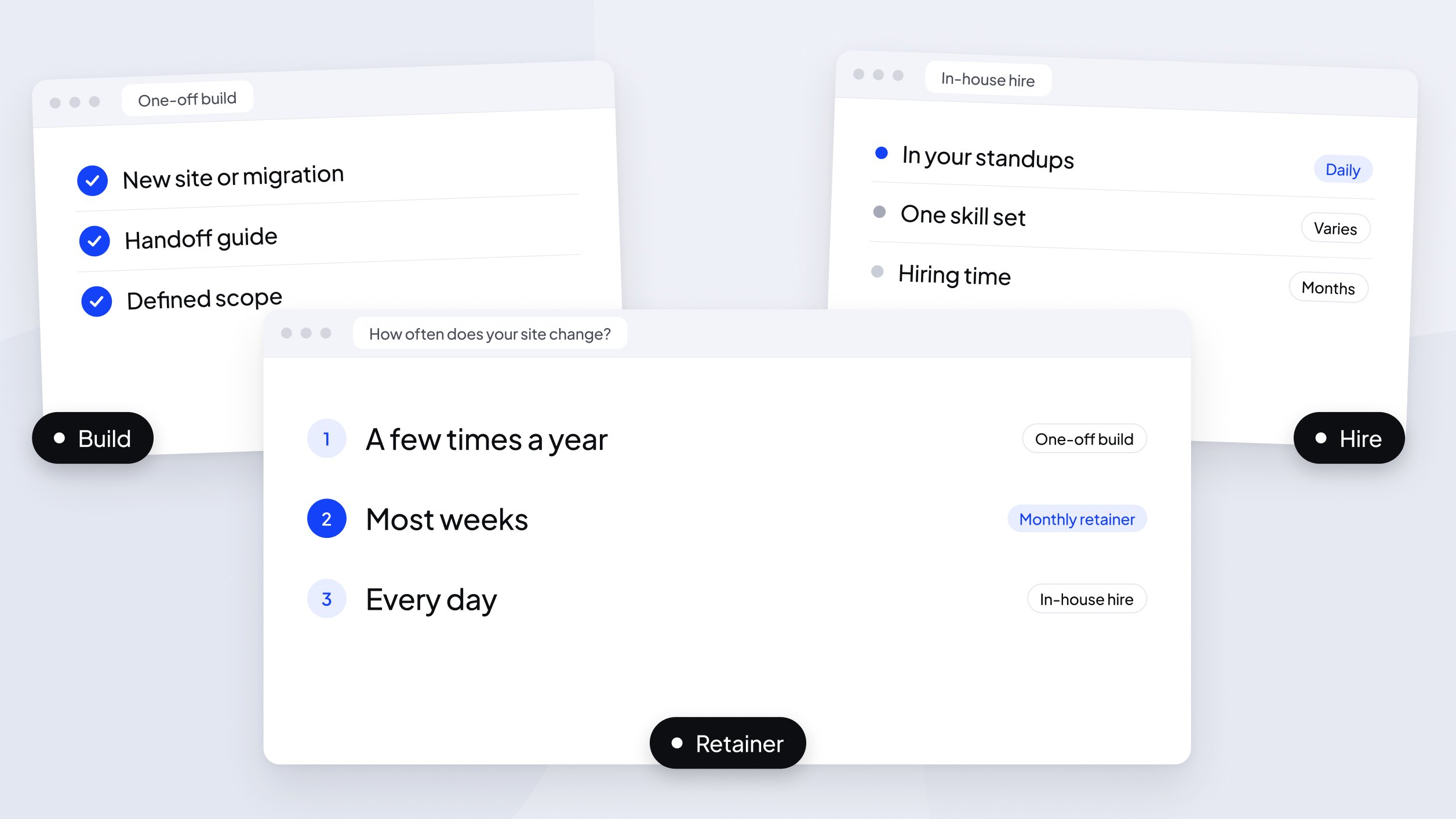
If your site changes every week but not every day, a Webflow retainer usually fits better than a hire. If it changes daily and needs someone in your meetings, hire. If you need one big change and then little else, scope a one-off build.
Any information contained on this Website is not legal advice and should not be treated as such. You should always contact an attorney for help with your specific legal needs and issues. We may also earn a commission when you click links to our partners and purchase goods or services. For more information, read our Disclaimers Policy.
If your website changes every week but not every day, a Webflow retainer usually fits better than an in-house hire. If it changes every day and needs someone in your meetings, hire. If you need one big change and then very little, scope a one-off build. Most five-person marketing teams sit in the middle, which is why a build followed by a monthly retainer is a common path.
Here's how to tell which situation you're in, and what each option is good at.
The short answer, by situation
- You need a new site, a rebuild, or a migration, and then mostly small edits. A one-off build with a documented handoff. Your team runs the site afterwards.
- You ship new pages, campaigns and fixes most weeks, and nobody on the team owns the site. A monthly retainer with a named owner and an agreed queue.
- The site changes daily, product and marketing depend on it, and you need someone in standups. An in-house web developer or web manager, often with outside help for big projects.
What a one-off build is good at
A build has a defined scope, a timeline and an end. It's the right shape when the work is one large change: a new site, a rebrand, or moving from WordPress to Webflow.
The risk sits at the end. The builder leaves, and your team owns a system it didn't design. That's fine when the site was built from named, reusable components and comes with a handoff guide your team can follow. It's painful when it wasn't. If you choose a one-off build, ask to see the handoff guide before you sign. Here's what a handoff guide should cover.
What a retainer is good at
A retainer is a monthly partnership for teams with a steady stream of website work: landing pages for campaigns, new case studies, component updates, SEO fixes, integrations and QA. You agree on priorities each month, the work moves through a visible queue, and one person is accountable for the site as a whole.
It fits when the backlog is real but doesn't justify a full-time salary, and when you want design, build and QA from people who already know the site. It's a poor fit when the work is so constant that you'd pay for more hours than a hire would cost, or so rare that the monthly capacity sits unused.
If you're moving from project work to a monthly arrangement, here's what changes month to month.
What an in-house hire is good at
A web developer on your team is in the room. They hear about the launch before the brief is written, they can fix something in ten minutes, and they build context no outside partner will match.
The trade-offs are cost and coverage. Beyond salary, there are benefits, tools, recruiting time and management. One person also covers one skill set: a strong developer may not be a designer, an SEO or a QA tester, and holidays and sick days pause the work. A single hire also becomes a single point of failure if the site lives only in their head.
Five questions that decide it
- How often does the site change? Count last quarter's website requests. A handful points to a build and occasional help. A steady weekly flow points to a retainer. Several a day points to a hire.
- Is the website your main marketing channel? If pipeline depends on landing pages and content, someone needs to own the site, inside or outside the team.
- Who decides what ships first? A retainer needs one person on your side to set priorities. Without that, any model stalls.
- Which skills does the work need? Design, development, CMS structure, SEO and QA rarely live in one person. A small team covers more of them.
- What happens when your web person leaves? Whichever model you choose, insist on documentation and accounts in your name.
For a five-person marketing team
A team this size usually has a demand generation lead, a content lead and a designer or two, and the website is everyone's second job. That's the situation a retainer suits: enough website work to need an owner, not enough to keep a full-time developer busy every day.
A practical sequence is to build first (or audit the current site), move into a monthly retainer, and revisit the decision every six months. When the queue outgrows the monthly capacity, that's the signal to hire, and a documented site helps the new person get up to speed faster.
You can combine them
The options aren't exclusive. Common combinations:
- Build, then retainer. The same people who built the site keep it moving, so nothing is lost at handoff.
- Retainer, then hire. The retainer keeps the site moving while you recruit, then helps the new hire get started.
- Hire plus partner. Your in-house developer handles daily work, and a partner takes on rebuilds and larger projects.
Frequently asked questions
Is a retainer cheaper than hiring?
Usually, when the work doesn't fill a full-time role. Compare the full cost of a hire (salary, benefits, tools, recruiting and management time) with monthly capacity sized to your real queue. When the queue would keep a full-time person busy, hiring often wins.
Can we switch later?
Yes, if the site is documented and the accounts are in your name. That's the single best protection for any of the three choices.
How long should a retainer run?
Ours run month to month. Review the arrangement on a schedule, and change it when your queue changes.
Next step
We build Webflow sites and keep them running for marketing teams. See how a build works, see how a monthly partnership works, or Start a project and we'll suggest the model that fits your queue.
When the fix becomes system work
We build Webflow sites and keep them running month to month, with one named owner for your site.
Start a project