
Any information contained on this Website is not legal advice and should not be treated as such. You should always contact an attorney for help with your specific legal needs and issues. We may also earn a commission when you click links to our partners and purchase goods or services. For more information, read our Disclaimers Policy.
Why Your B2B SEO Content Strategy Needs a Complete Overhaul in 2025
A B2B SEO content strategy is a systematic approach to creating and optimizing content that attracts business decision-makers through search engines, ultimately driving qualified leads and revenue. Unlike B2C strategies, it focuses on high-intent keywords, longer sales cycles, and content that addresses multiple stakeholders in the buying process.
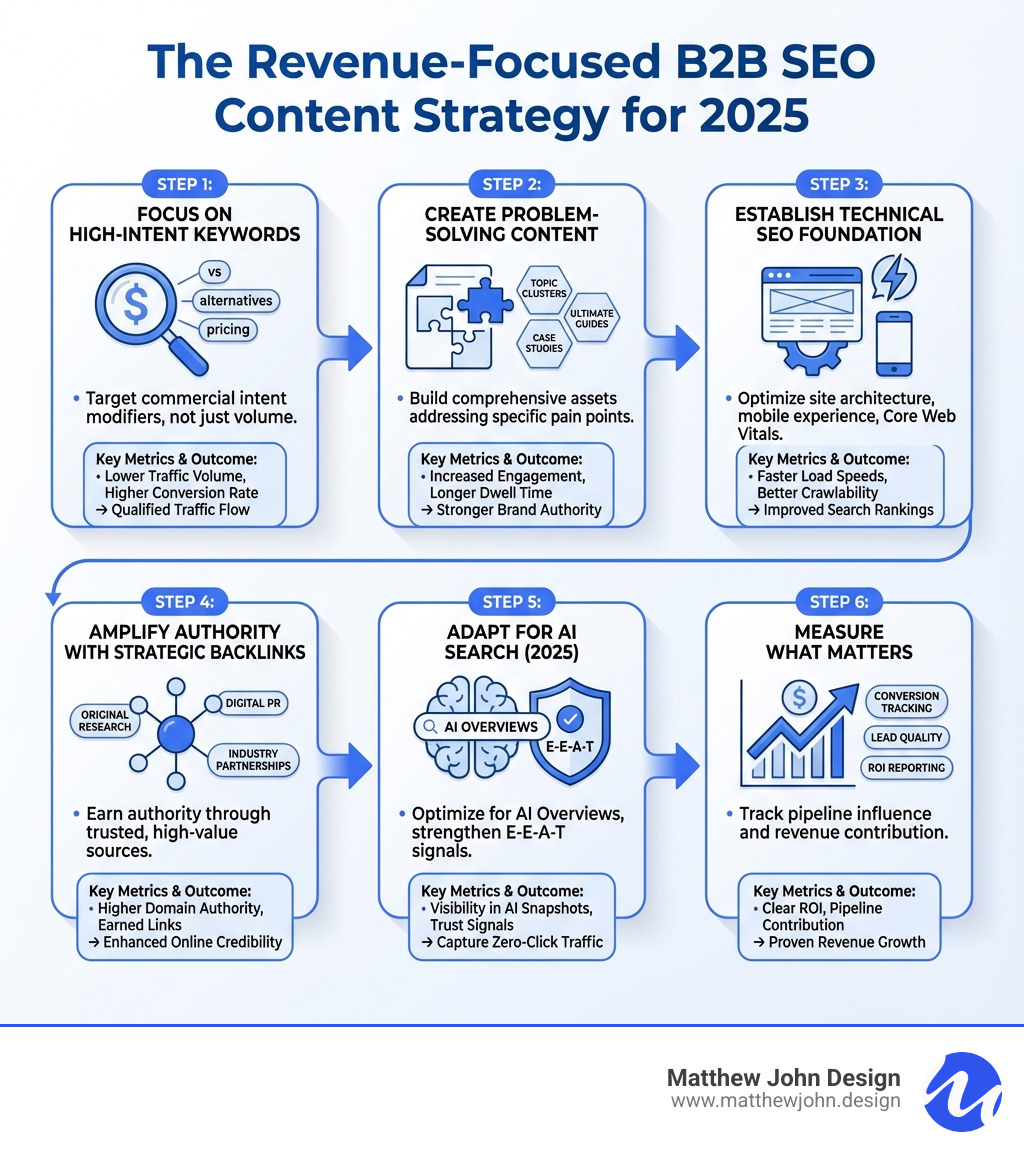
Here's what an effective B2B SEO content strategy includes:
- High-intent keyword targeting - Focus on commercial terms like "solution," "alternatives," "vs," and "pricing" rather than high-volume informational keywords
- Problem-solving content - Create ultimate guides, case studies, and resources that address specific business pain points
- Technical SEO foundation - Ensure fast load times, mobile optimization, and proper site structure for search engine crawlability
- Strategic backlink building - Earn authority through original research, industry partnerships, and digital PR
- AI-optimized content - Adapt for AI search tools and zero-click searches while strengthening E-E-A-T signals
- Conversion tracking - Measure lead quality, attribution, and ROI rather than vanity metrics like traffic volume
Most B2B companies are wasting their SEO budget. They chase high-volume keywords that sound impressive in reports but convert at less than 1%. They publish generic blog posts that rank well but speak to no one. They celebrate traffic increases while their sales team complains about lead quality.
The data tells a different story. 61% of B2B marketers say that SEO and organic traffic generate more leads than any other marketing initiative, yet most companies are optimizing for the wrong metrics entirely. They're targeting keywords with 10,000 monthly searches instead of the 50-search keyword that represents a $500K annual contract.
Here's the uncomfortable truth: your competitors ranking on page one aren't necessarily making more money than you. They might just be better at looking busy.
The shift to bottom-of-funnel (BOFU) SEO changes everything. Instead of educating browsers who may never buy, you're capturing buyers actively evaluating solutions. Instead of measuring rankings, you're tracking pipeline influence. Instead of generic "thought leadership," you're creating content that answers the exact questions your sales team hears on findy calls.
This approach works because B2B buyers have fundamentally changed how they research. They conduct 12 different online searches before they even talk to sales. They're looking for specific answers to specific problems. And if you're not there with content that speaks directly to their needs, they're finding your competitor instead.
The companies winning at B2B SEO in 2025 aren't the ones with the most blog posts. They're the ones who understand that organic search generates 53.3% of traffic for B2B brands and delivers two times more revenue than any other channel. They've stopped chasing vanity metrics and started building content strategies that directly impact their bottom line.
This guide walks you through exactly how to build that strategy. No fluff. No generic advice about "creating quality content." Just the tactical, revenue-focused approach that turns SEO from a traffic generator into a pipeline driver.
B2b seo content strategy helpful reading:
Table of Contents
- Introduction
- Building Your B2B SEO Content Strategy Foundation
- Step 1: Focus on High-Intent Keywords That Drive Revenue
- Step 2: Create Problem-Solving Content for Your B2B SEO Content Strategy
- Step 3: Establish a Flawless Technical SEO Foundation
- Executing and Measuring Your High-Impact Strategy
- Step 4: Amplify Authority with Strategic Backlinks & Digital PR
- Step 5: Adapting Your B2B SEO Content Strategy for AI Search
- Step 6: Measure What Matters: Tracking Conversions and SEO ROI
Building Your B2B SEO Content Strategy Foundation

Building a successful B2B SEO content strategy is much like constructing a robust building: it requires a strong foundation. This foundation isn't just about throwing up keywords and hoping for the best; it's about deeply understanding who your ideal customer is, what problems they need solved, and how your business offers the definitive solution. Without this clarity, all your SEO efforts risk being built on shaky ground, leading to traffic that doesn't convert and budgets that disappear into the ether.
For B2B brands, organic search is a powerhouse, generating 53.3% of traffic. But it's not just about traffic volume; it's about qualified traffic that translates into tangible business outcomes. Our focus is on ensuring every piece of content, every technical optimization, and every keyword targets decision-makers who are ready to engage and buy.
Step 1: Focus on High-Intent Keywords That Drive Revenue
The biggest mistake we see B2B companies make is chasing high-volume, top-of-funnel (TOFU) keywords that bring in curious browsers, not potential buyers. While TOFU content has its place in a broader strategy, for a revenue-focused B2B SEO content strategy, we start at the bottom: with high-intent, bottom-of-funnel (BOFU) keywords.
Keywords with commercial intent boast conversion rates 10 times higher than purely informational ones. Think about it: a search for "what is CRM software" is very different from "best CRM software for small business pricing." The latter indicates a buyer who is much closer to making a decision. Unfortunately, over 70% of content on many B2B software websites still targets purely informational keywords, missing out on these high-value opportunities.
We prioritize keywords that capture prospects actively evaluating solutions and comparing options. This means looking for specific keyword modifiers that signal purchase intent, such as:
- "vs" or "alternatives": When buyers are comparing your solution against others.
- "pricing" or "cost": Indicating they're ready to understand the investment.
- "solution" or "platform": When they're looking for a specific type of offering.
- "demo" or "trial": Showing a clear intent to experience the product.
To uncover these goldmines, we don't just rely on keyword tools. We leverage insights directly from your sales team and customer conversations. Your sales reps are on the front lines, hearing the exact language, pain points, and objections your prospects have. This invaluable feedback can directly inform your keyword research, helping us pinpoint terms that resonate with buyers in market.
We also conduct a thorough content gap analysis. This isn't just about finding keywords you don't rank for, but identifying high-intent keywords that your ideal customers are searching for, and where your current content falls short. The goal is to fill these gaps with highly targeted content that directly addresses their needs.
We prioritize keywords based on their business value, not just search volume. A keyword with 50 monthly searches that converts at 8% is far more valuable than one with 5,000 searches that converts at 0.2%. It's about optimizing for revenue, not just vanity metrics.
For effective keyword findy, tools like Answer the Public can help you visualize questions and phrases related to your core topics, giving you a glimpse into what your audience is really asking. Additionally, Moz Keyword Explorer provides valuable data on search volume, keyword difficulty, and related terms, helping us identify high-potential keywords.
Understanding the difference between a keyword and its underlying intent is crucial for any SEO effort. If you're curious about the basics, we've got a helpful guide explaining What Does SEO Stand For.
Step 2: Create Problem-Solving Content for Your B2B SEO Content Strategy
Once we've identified those high-intent keywords, the next step in our B2B SEO content strategy is to create content that doesn't just rank, but actively solves problems for your target audience. B2B buyers aren't looking for quick answers; they're looking for comprehensive solutions to complex business challenges. Their buying journey is longer, involving multiple stakeholders, and they need content that guides them every step of the way.
This is where building topic clusters and pillar pages becomes incredibly powerful. Instead of isolated blog posts, we organize your content around core business solutions, creating authoritative "pillar" articles that cover a broad topic in depth. These pillars are then supported by a cluster of more specific articles that link back to the pillar, establishing your website as a definitive resource. This structure not only helps search engines understand your topical authority but also provides a clear, logical path for your buyers to follow as they research.
The types of content that perform best for B2B SEO in this context are:
- Ultimate Guides: Comprehensive resources that address every aspect of a specific problem or solution. These are often long-form, 2,000-5,000+ words, and are highly effective for attracting both users and backlinks.
- Case Studies: Real-world examples of how your product or service has solved problems for other businesses. These are crucial for the BOFU stage, providing social proof and demonstrating ROI.
- Solution-Focused Resources: Whitepapers, detailed comparison guides, ROI calculators, and interactive tools that help buyers understand the value and implementation of your offerings.
To truly resonate, this content must demonstrate E-E-A-T: Experience, Expertise, Authoritativeness, and Trust. This isn't just a buzzword; it's how Google assesses whether your content is helpful and reliable. We achieve this by leveraging your internal subject matter experts. Who better to explain the nuances of your product or service than the engineers who built it, the consultants who implement it, or the sales team who understands customer challenges inside out? Content based on experience and unique insights aligns perfectly with E-E-A-T guidelines and performs better in search.
We ensure your content directly addresses the specific pain points and objections of your Ideal Customer Profile (ICP). This means moving beyond generic descriptions and diving into the "how-to" and "why" behind your solutions. If a prospect is concerned about implementation time, we create content that details a smooth onboarding process. If they're worried about integration, we provide guides on how your solution works with their existing tech stack. This problem-solving approach is what converts researchers into qualified leads.
For a deeper dive into crafting content that truly performs, explore our guides on Content for SEO and mastering Search Engine Optimisation Copywriting.
Step 3: Establish a Flawless Technical SEO Foundation

Imagine building a beautiful, problem-solving content strategy, only for your website to crumble under the weight of poor technical performance. It's like having the best product in the world but keeping it locked in a broken safe. Technical SEO is the bedrock of your entire B2B SEO content strategy. Without a flawless foundation, even the most brilliant content will struggle to rank and convert.
We prioritize technical SEO because it directly impacts both search engine crawlability and user experience (UX), which are increasingly intertwined. Google, for instance, has long prioritized mobile-friendly websites in its rankings, and this "mobile-first indexing" approach applies across all industries, including B2B.
Key technical elements we focus on include:
- Structuring Site Architecture: A clear, logical site structure makes it easy for both search engines to crawl and users to steer. We ensure your website is organized in a way that highlights your most important content and solutions, guiding users naturally through their buyer's journey.
- Ensuring Mobile-First Indexing and Responsive Design: With 60% of B2B buyers using their phones at some point during a buying journey, your website must look and perform flawlessly on mobile devices. Responsive design ensures your site adapts seamlessly to any screen size.
- Optimizing Page Speed and Core Web Vitals: Google's Core Web Vitals (Largest Contentful Paint, First Input Delay, Cumulative Layout Shift) are crucial metrics for measuring UX. A slow-loading page frustrates users and signals poor quality to search engines. We optimize images, minimize code, and leverage technologies like Content Delivery Networks (CDNs) to ensure your site is lightning-fast.
- Implementing Schema Markup: Schema markup (or structured data) is code that helps search engines better understand the content on your pages. For B2B, this can include Product schema for your offerings, Organization schema for your company details, or FAQ schema for common questions. This improves your visibility in rich snippets and other improved search results. You can use tools like Google’s Schema Markup Generator to create this.
- Prioritizing Accessibility (WCAG): Accessibility isn't just good practice; it's a legal and ethical imperative. Adhering to Web Content Accessibility Guidelines (WCAG) ensures your website is usable by everyone, including those with disabilities. This also contributes to a better overall user experience, which search engines reward.
At Matthew John Design, we specialize in building scalable Webflow sites with reusable components and optimized CMS structures. This approach inherently supports strong technical SEO, enabling your marketing team to launch pages and campaigns without developer delays, all while maintaining a healthy, high-performing website. For more specific insights on optimizing your Webflow site, check out our Webflow SEO 5 Tips.
Executing and Measuring Your High-Impact Strategy
Once your foundation is solid and your problem-solving content is taking shape, the next phase of your B2B SEO content strategy shifts to execution, amplification, and rigorous measurement. This is where we ensure your efforts translate directly into business growth, not just abstract SEO scores. The goal isn't just to rank; it's to convert.
We know that B2B SEO is a long game. It typically takes around six months to one year to see initial results, with the highest ROI often appearing after two or three years. This isn't for the faint of heart, but the returns can be phenomenal. For example, B2B SaaS companies have seen an SEO return on ad spend (ROAS) of $8.75, which translates to an ROI of 702%! This kind of long-term thinking, coupled with smart execution and precise measurement, is what drives that kind of success.
Step 4: Amplify Authority with Strategic Backlinks & Digital PR
Backlinks remain a critical factor in B2B SEO, signaling credibility and authority to search engines. However, in the B2B space, this isn't about chasing every link imaginable. It's about earning high-quality, relevant links from authoritative sources that your target audience trusts. Our approach is strategic, focusing on building authority that directly supports your sales funnel.
Here's how we amplify your authority:
- Creating Link-Worthy Content: The best way to earn backlinks is to create something truly valuable that others want to reference. This includes:
- Original Research & Data Studies: Publish unique insights, industry reports, or proprietary data that no one else has. Content with original research often receives 4 times more backlinks and 3 times more social shares.
- Free Tools & Calculators: Develop useful, interactive tools (e.g., an ROI calculator, a project cost estimator) that solve a real problem for your audience. These assets naturally attract links because they provide ongoing value.
- Comprehensive Guides & Resources: If your content in Step 2 is truly exceptional, it will naturally become a go-to resource for others, earning organic links.
- Building Relationships with Industry Publications and Partners: We actively seek out opportunities to collaborate with non-competing businesses and industry publications that share your target audience. This could involve co-creating content, offering expert commentary, or being featured in their resource sections.
- Leveraging Digital PR and Guest Posting: Digital PR involves strategically pitching your unique stories, data, or expert insights to relevant industry blogs, news sites, and podcasts. Guest posting on authoritative platforms allows you to share your expertise with new audiences and earn valuable backlinks. The key is to focus on platforms where your ideal customer spends their time.
- Focusing on Quality Over Quantity: A single, high-quality backlink from a respected industry authority is worth far more than dozens of low-quality, spammy links. We avoid risky strategies like buying backlinks, as these offer low ROI and can even harm your SEO.
Building quality backlinks is an inbound strategy – it's about making your content so valuable that others naturally want to link to it. For more detailed information on how we approach this, explore our SEO Content Links services.
Step 5: Adapting Your B2B SEO Content Strategy for AI Search
The SEO landscape is constantly evolving, and the rise of AI in search has introduced new complexities and opportunities for your B2B SEO content strategy. Google has explicitly stated its plans to integrate more AI experiences into the user's search journey, and AI-generated search results (like AI Overviews in Google's Search Generative Experience, SGE) are already impacting how users consume information.
Here’s how we adapt to this new frontier:
- Understanding AI Overviews (Search Generative Experience, SGE) and Zero-Click Searches: AI Overviews can provide direct answers to user queries, potentially reducing the need for users to click through to your website. This means our content needs to be so compelling and authoritative that it gets cited directly by AI, or it encourages a click-through for deeper insights. While AI is growing, 99% of AI users still rely on search engines for factual answers, meaning traditional search is far from obsolete.
- Optimizing for Brand Mentions and Quotable Content: To appear in AI-generated answers, we strategically create content that includes your business name alongside key phrases. This involves crafting clear, concise, and quotable sections within your content that AI models can easily extract and attribute. The goal is to train AI models to recognize your brand as the definitive source for specific solutions or information.
- Strengthening E-E-A-T Signals: In an AI-driven world, trust and authority are more critical than ever. We double down on demonstrating your Experience, Expertise, Authoritativeness, and Trust (E-E-A-T). This means featuring expert authors, backing claims with data, showcasing case studies, and ensuring your content provides genuinely unique and valuable perspectives that AI models (and human users) can rely on. If your content is generic or lacks real insight, it's less likely to be cited by AI or trusted by users.
The future of B2B SEO isn't just about keywords; it's about becoming the most trusted and cited voice in your industry. This requires a nuanced approach to content creation that anticipates how AI will process and present information. For a deeper dive into this area, explore our insights on AI Driven SEO Content Creation.
Step 6: Measure What Matters: Tracking Conversions and SEO ROI
The final, and arguably most critical, step in a revenue-focused B2B SEO content strategy is measuring what truly matters: conversions and ROI. We move beyond vanity metrics like raw traffic volume and focus on how your SEO efforts directly contribute to your pipeline and bottom line. If you're not tracking conversions, you're essentially flying blind.
Our approach centers on:
- Setting Up Robust Conversion Tracking and Attribution Models: Before any content goes live, we ensure comprehensive conversion tracking is in place. This includes tracking form submissions, demo requests, content downloads, and any other micro-conversions that indicate buyer intent. We then implement attribution models (like first-touch, last-touch, or multi-touch) to accurately credit SEO for its role in the buyer's journey. This is crucial because B2B sales cycles are long, and SEO often influences multiple touchpoints.
- Measuring Lead Quality (Marketing Qualified Leads, Sales Qualified Leads): It's not enough to generate leads; we need to ensure they're qualified. We work with your sales team to define what constitutes a Marketing Qualified Lead (MQL) and a Sales Qualified Lead (SQL) and track how many of these are generated through organic search. This ensures our SEO efforts are bringing in prospects who are a good fit for your business and ready to engage with sales.
- Defining and Reporting on Key Performance Indicators (KPIs) that Align with Business Goals: Our KPIs extend beyond rankings and traffic. We focus on metrics like:
- Organic Conversion Rate
- Cost Per MQL/SQL from Organic Search
- Pipeline Influence from Organic Search
- SEO ROI (e.g., B2B SaaS companies seeing an ROI of 702%)
- Using Reporting Frameworks to Demonstrate ROI and Inform Strategy Adjustments: We don't just collect data; we turn it into actionable insights. This involves:
- Custom Dashboards: Creating dedicated dashboards in tools like Google Analytics, or business intelligence platforms like Tableau or Power BI, to provide a real-time view of SEO performance against business goals.
- Regular Reporting: Providing clear, concise reports that highlight key successes, identify areas for improvement, and demonstrate the financial impact of your SEO efforts.
- Continuous Optimization: The SEO landscape is dynamic. We continuously analyze performance data to refine keyword strategies, optimize existing content, and identify new opportunities. This iterative process ensures your B2B SEO content strategy remains agile and impactful.
B2B SEO is an investment that compounds over time. While instant results are rare, consistent effort and a focus on revenue-driving metrics will yield significant long-term growth. For comprehensive support in setting up and managing your SEO content creation and tracking, learn more about our SEO Content Creation services.
.jpg)