
Direct answer
What is a Website Experience Manager?
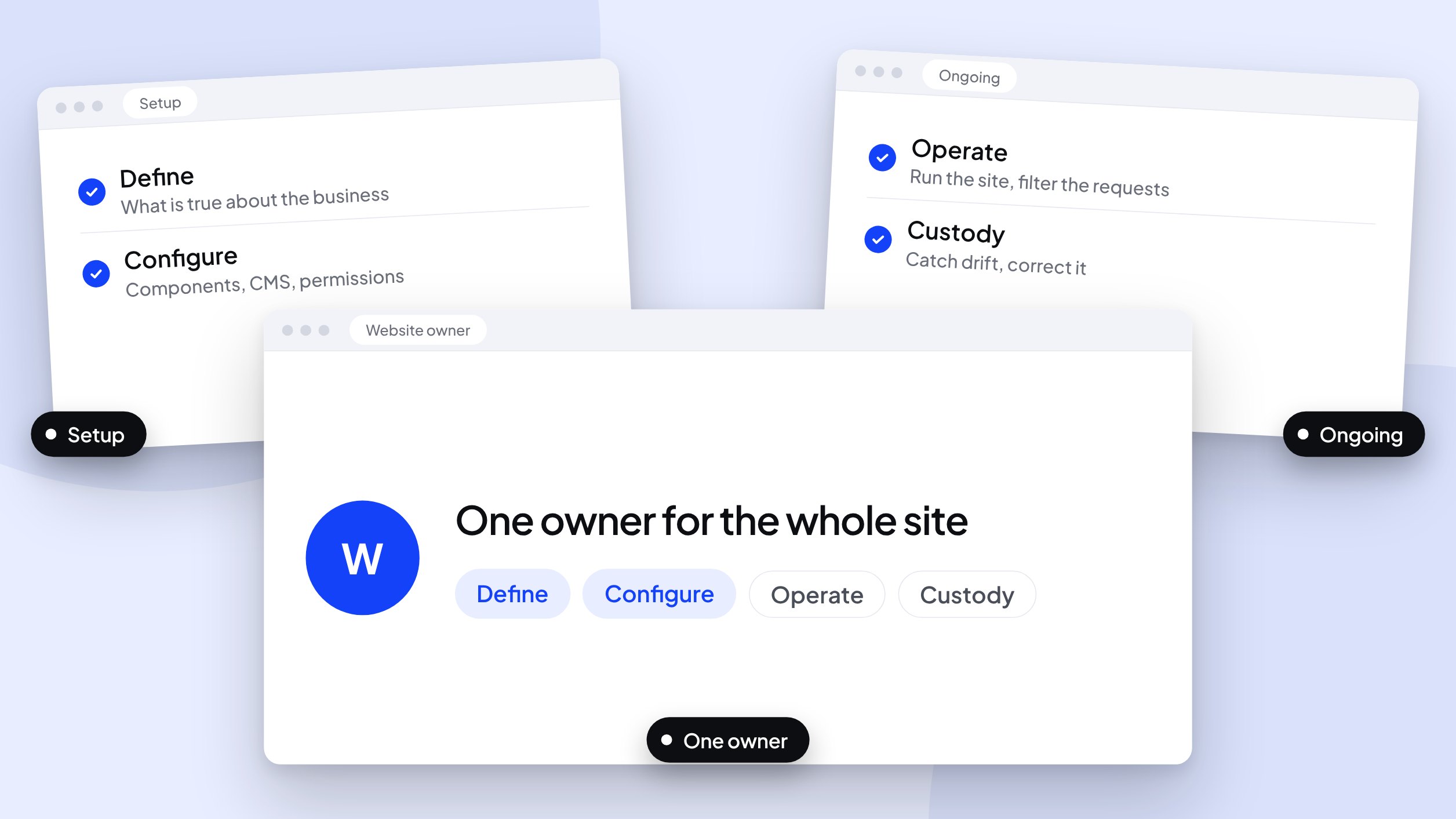
A Website Experience Manager is one accountable owner for your Webflow site. They define what’s true about your business, configure the system, run the site day to day, and review it over time, so your marketing plan doesn’t stall at the website.
Any information contained on this Website is not legal advice and should not be treated as such. You should always contact an attorney for help with your specific legal needs and issues. We may also earn a commission when you click links to our partners and purchase goods or services. For more information, read our Disclaimers Policy.
You hired a fractional CMO to build a marketing strategy. They delivered a clear roadmap for lead generation and brand positioning. The problem? That roadmap hits a wall the moment it gets to the website.
The landing page for your new service is stuck in a queue. An A/B test for the pricing page needs a developer who’s booked for weeks. Your team is afraid to touch the Webflow CMS because the last time someone tried, three pages broke.
This is the gap between strategy and execution. It’s where marketing momentum stalls.
Standard Webflow support, often run like an IT help desk, isn’t built for this. You submit a ticket, someone completes the task, and the ticket closes. That reactive, task-based approach gives nobody ownership of the site as a whole. Your marketing team probably has an owner for paid, SEO, and the CRM. The website usually has none.
That missing owner is the Website Experience Manager (WEM): a dedicated person who owns your Webflow site and bridges your marketing strategy and the technical work of building, running, and protecting it.
What a Website Experience Manager does
The role has four jobs. Two happen at the start and get revisited. Two continue for as long as the engagement runs.
- Define. Write down what’s true about your business so people and tools build against the same source: positioning, messaging, brand system, component conventions, and what the site won’t say.
- Configure. Set up the guardrails: the component library, CMS structure, permissions, and instructions for any AI tools that touch the site.
- Operate. Run the site day to day. Direct the work, sequence incoming requests, and reconcile conflicting asks against what’s already live. Some requests aren’t approved, aren’t ready, or conflict with something else, so the queue works as a filter, not a to-do list.
- Custody. Watch the site over time. Brand systems drift, contributors publish items that contradict the messaging, and instructions written in March stop describing the business by September. A regular review catches that and corrects it.
The last two jobs are why this is an ongoing role, not a one-time project. Someone has to stay accountable for what’s live.
The difference between a Webflow developer and a Website Experience Manager
Hiring a “Webflow developer” can mean many things. You might get a freelancer who can build a page from a Figma file, or an agency that takes weeks to turn around minor copy edits. A Website Experience Manager works on a different model.
- Task-based vs. outcome-based: A typical developer waits for a detailed brief. You ask for a new “Features” component, and that’s what you get. A Website Experience Manager starts with the goal. You want more trial sign-ups, so they identify the need for a comparison component and revised social proof, then build them. They think about the marketing KPI, not just the build request.
- Ownership of the handoff guide: The line between a site you can manage and one that holds you hostage is documentation. A developer’s job often ends at deployment. A Website Experience Manager’s job includes a handoff guide that explains the components, CMS structure, and style classes, so your team can make routine updates with confidence. The site becomes an asset you control, not a black box.
- An extension of your marketing team: A fractional CMO can’t spend limited hours managing a vendor’s ticket queue. The Website Experience Manager works alongside your team, understands your quarterly goals, and suggests site improvements that help you reach them. They become the execution arm that brings the CMO’s roadmap to life in Webflow.
- Proactive quality assurance: When a developer adds a page, they test that page. A Website Experience Manager owns the quality of the entire site: responsive behavior, accessibility, and whether new additions affect older pages. That ownership prevents the slow build-up of bugs and technical debt.
Why component-based builds are the foundation of good management
You can’t effectively manage a website built from static, one-off pages. A scalable, manageable site rests on a component-based system. This approach is central to how a Website Experience Manager works and is a core principle of every Webflow-first build.
Instead of building individual pages, the build produces a library of named, reusable components: “Hero with Form,” “3-Column Feature Grid,” “Customer Logo Wall.” Your marketing team can assemble new landing pages or update layouts by combining these pre-built, on-brand components.
This system solves several problems:
- It reduces technical debt. When every page is built from a consistent set of components, the Webflow project stays clean and organized. There are no rogue styles or duplicated structures to make future updates a headache. The manager’s job is to maintain the system so it evolves without becoming messy.
- It simplifies the CMS. A common complaint from marketing teams is that the Webflow CMS is confusing. That usually happens when a site is built without a clear content strategy. A Website Experience Manager builds the CMS with the end user in mind: fields have clear names and help text, and collections match how your team thinks about content.
- It enforces brand consistency. The manager maintains the central design system. When a campaign needs a new landing page, it’s built from the established components, so every new page, blog post, or case study follows your guidelines for typography, color, and spacing.
A site built with components is built for growth. It gives your marketing team speed and flexibility, while the Website Experience Manager keeps the underlying system sound.
Why a launched site still needs an owner
A launch is the start of the workload, not the end. New pages, campaigns, integrations, and contributors arrive for as long as the site is part of your marketing. Without a clear owner, even a well-built site stagnates or drifts.
This is where a dedicated ongoing website support relationship fits. It gives you the benefits of a senior, in-house web lead without the cost and commitment of a full-time hire.
A retainer model shifts the relationship from transactional to strategic. Instead of scoping every change request, you have a dedicated partner available to manage the roadmap. That allows:
- Proactive growth work. The focus moves from fixing what’s broken to building what’s next: new SEO content structures, landing pages for product features, and refined user flows.
- Technical heavy lifting. Your fractional CMO shouldn’t be wrestling with DNS settings or API integrations. A Website Experience Manager handles the technical work behind the scenes, such as localization setup, confirming analytics fire correctly, and checking that forms route into your CRM.
- Fewer contract negotiations. When new needs arise, and they always do, they’re absorbed into the ongoing workflow. You don’t renegotiate a contract to add a case study template or update integration partners on the homepage.
Common questions about Webflow management and support
What is the difference between Webflow support and maintenance?
Maintenance is mostly passive. It keeps the lights on: hosting, security, and uptime, which the Webflow platform handles natively.
Website support, as the Website Experience Manager role defines it, is active and growth-oriented. It improves and expands the site to achieve specific business outcomes. You’re not paying for insurance. You’re investing in forward momentum.
How much does a Website Experience Manager cost?
It depends on how many sites you run and how much build activity your team has, so engagements are scoped to your situation. A useful comparison is the full cost of a senior full-time web hire, including the management that comes with one. Start a project and we’ll scope it with you.
Do I need a Website Experience Manager if I already have a designer?
Yes, the roles are distinct. A designer is responsible for the user experience, visual identity, and brand strategy. They produce the “what” and the “why” in a tool like Figma.
A Website Experience Manager is the technical bridge who turns that design into a functional, scalable, and manageable Webflow site. They own the “how.” They make sure the build is not only pixel-perfect but also structured with clean components, a logical CMS, and solid performance.
Can a Website Experience Manager help with SEO?
A Website Experience Manager isn’t an SEO strategist, but is a key partner in executing an SEO strategy. They’re responsible for the technical implementation that lets your content rank:
- Building flexible CMS collections for different content types (blog posts, case studies, resources).
- Setting correct heading structures, meta fields, and schema markup on page templates.
- Optimizing image sizes and site speed to meet Core Web Vitals.
- Implementing 301 redirects and managing the technical side of content migrations.
They build the high-performance vessel. Your SEO or content team provides the cargo.
Secure a true owner for your website
Your website should be your marketing team’s most powerful asset, not its biggest bottleneck. With a Website Experience Manager, you get a site that scales with your business and a team that isn’t afraid to use it. You get an embedded partner who makes sure your CMO’s strategic roadmap becomes a reality.
If your team is ready for a more strategic approach to your web presence, review how ongoing support works.
Or, if you have a defined scope in mind, Start a project to connect with a dedicated Webflow expert.
