
Any information contained on this Website is not legal advice and should not be treated as such. You should always contact an attorney for help with your specific legal needs and issues. We may also earn a commission when you click links to our partners and purchase goods or services. For more information, read our Disclaimers Policy.
Why Marketing Content Creation Matters for Your Business
Marketing content creation is the process of producing and distributing digital assets—like blog posts, videos, and social media content—to attract, engage, and convert a target audience. It's about turning ideas into valuable collateral that addresses customer needs while advancing business goals.
Quick Answer: The Marketing Content Creation Process
- Strategy & Research - Define your audience, map the buyer's journey, and conduct keyword research
- Ideation & Planning - Generate topic ideas, create content clusters, and build an editorial calendar
- Creation & Optimization - Produce high-quality content optimized for search engines and user experience
- Promotion & Distribution - Share content across channels including social media, email, and partnerships
- Measurement & Refinement - Track KPIs, analyze performance, and continuously improve based on data
Content creation is the foundation of modern digital marketing. Instead of relying on interruption-based advertising, successful companies invite customers in with relevant content that builds trust and establishes authority. Strategically, this leads to improved brand visibility, stronger customer relationships, better SEO performance, and more qualified leads.
However, quality trumps quantity. Great content drives business results, while poor content gets lost online. Your brand's reputation hinges on producing well-researched, well-designed content that puts your audience first.
For business owners and CMOs, the challenge isn't whether to create content, but how to build a scalable system that aligns with strategic goals. This guide provides a complete framework for mastering marketing content creation, from initial strategy to final measurement.
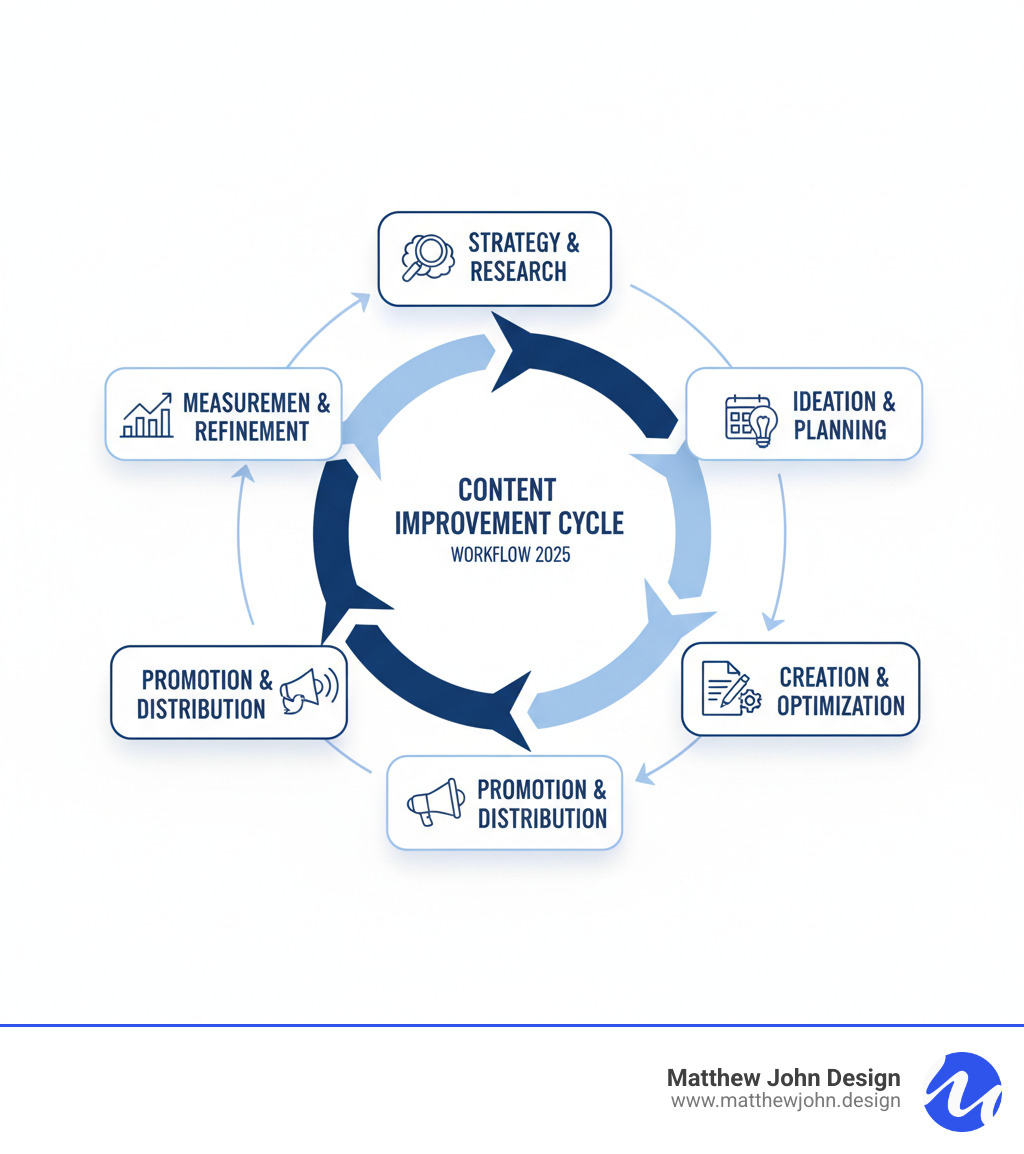
Table of Contents
- Introduction: The Foundation of Modern Digital Marketing
- The Strategic Process of Marketing Content Creation
- Step 1: Strategy, Ideation, and SEO Research
- Step 2: Crafting Different Types of Content
- The Marketing Content Creation Workflow
- Advanced Marketing Content Creation with AI and Personalization
- Step 5: Measuring Success and Overcoming Challenges
- Conclusion: Scale Your Content and Drive Growth
The Strategic Process of Marketing Content Creation
Effective marketing content creation is a deliberate process that starts with deep audience understanding and ends with measurable business impact. Before creating anything, a solid content strategy is essential to connect your efforts to business goals.
Step 1: Strategy, Ideation, and SEO Research
This foundational stage answers the critical questions: Why are we creating this content? Who is it for? What should it accomplish?
- Build Audience Personas: Create detailed profiles of your ideal customers, including their job roles, pain points, and the solutions they seek. Understanding your audience makes your content more relevant.
- Map the Buyer's Journey: Tailor content to each stage:
- Awareness: Educational, problem-focused content.
- Consideration: Solution-oriented content that positions your brand as a guide.
- Decision: Case studies and testimonials to build confidence.
- Conduct Keyword Research: Identify the terms your audience uses in search engines. Tools like Google Keyword Planner, Semrush, and Ahrefs help find valuable keywords. This is a critical step for SEO Content Creation to ensure your content gets found.
- Organize Topics into Clusters: Create comprehensive "pillar" pages on broad topics, supported by specific "cluster" articles that link back to the pillar. This hub-and-spoke model signals expertise to search engines.
- Generate Fresh Ideas: Use tools to find what your audience is asking. Answer the Public reveals search queries, BuzzSumo shows what content is performing well, and Quora highlights real-time questions.
Step 2: Crafting Different Types of Content

With a strategy in place, choose the right formats to deliver your message. A mix of content types is often most effective.
- Written Content: Includes blog posts for SEO, white papers/ebooks as lead magnets, concise website copy, and newsletters. Tools like Grammarly and The Hemingway App improve clarity.
- Visual Content: Captures attention quickly. Infographics simplify complex data; use tools like Piktochart or Canva to create them. Branded graphics ensure consistency. High-quality stock photos from sites like Morgue File or Flickr's Creative Commons can supplement original visuals.
- Video Content: Excellent for demonstrations and storytelling. Keep videos concise with good audio, and always include captions for accessibility. For hosting, Webflow only supports background videos up to 30 MB. For larger files, Webflow does not offer native hosting; we recommend third-party solutions like YouTube, Vimeo, or Vidzflow for optimal performance. Our SEO Writing and Video services can help optimize your multimedia content.
- Audio Content: Reaches audiences on the go. Podcasts are great for long-form interviews, while short audio snippets can be shared on social media.
- Interactive Content: Encourages user participation. Quizzes, polls, and calculators provide personalized value. For web use, always choose web-native formats like HTML, SVG, or iframes. Avoid interactive PDFs, as their poor web and mobile support can create a frustrating user experience.
The Marketing Content Creation Workflow
A reliable workflow turns ideas into published content consistently. A structured process includes:
- Research: Gather information on the brand, product, and audience.
- Brainstorming: Generate a wide range of ideas and angles.
- Incubation: Step away to allow for fresh perspectives.
- Validation: Critique ideas against a checklist: Is it useful, on-brand, and aligned with business goals?
- Prototyping: Create simple samples to test concepts before full production.
- Creation: Craft the final piece based on all gathered insights.
A collaborative team is key. Essential roles include a content strategist, writer, designer, and project manager. Whether to build an in-house team or outsource depends on your resources and needs. If your team is stretched thin, outsourcing to an agency can provide specialized skills and capacity. Our Content Marketing for SEO services are designed to support businesses in this situation.
Advanced Marketing Content Creation with AI and Personalization
Modern tools and strategies can lift your content.
- Artificial Intelligence (AI): Use AI tools like ChatGPT for ideation, outlines, and first drafts. However, human oversight is essential to ensure quality, brand voice, and compliance with Google's Search Essentials. AI is a powerful assistant, not a replacement for human creativity. Learn more from our guide on AI Tools for SEO Content Creation.
- Personalization: Tailor content based on user data to increase relevance. For example, Spotify Wrapped uses personal listening data to create a highly shareable experience.
- User-Generated Content (UGC): Encourage customers to share reviews or stories related to your brand. UGC builds authenticity and trust.
- Content Shareability: Create content people want to share by focusing on utility (helpful resources), incentives (competitions), and topicality (tapping into trends).
- Content Licensing: Fill gaps in your editorial calendar by obtaining rights to use high-quality content created by others.
Step 5: Measuring Success and Overcoming Challenges

How do you know if your content is working? Measurement is essential.
- Track Key Performance Indicators (KPIs): Focus on metrics that align with your goals, such as website traffic, engagement (time on page, shares), conversions (leads, sales), and SEO results (keyword rankings).
- Focus on Value Metrics: Distinguish between "vanity" metrics (e.g., raw page views) and "value" metrics (e.g., conversion rates) that directly tie to business impact.
- Use Analytics Tools: Tools like Google Analytics for website performance, Parse.ly for real-time engagement, and Moz for SEO tracking provide crucial insights. Our guide to Content for SEO offers more on this topic.
Common challenges include creative block, budget constraints, and content fatigue. Overcome them by staying agile, committing to continuous learning, and optimizing your workflow based on data. An iterative approach separates content teams that thrive from those that merely survive.
Conclusion: Scale Your Content and Drive Growth
We've covered the entire landscape of marketing content creation, from strategy and ideation to production, personalization, and measurement. The key takeaway is that great content is created with purpose. It requires knowing your audience, choosing quality over quantity, and constantly refining your approach based on data. This commitment builds trust, deepens engagement, and guides visitors toward becoming loyal customers.
The beauty of modern marketing content creation is that you don't have to do it alone. At Matthew John Design, we empower marketing teams with scalable Webflow sites built with reusable components and intuitive CMS structures. This puts control back in your hands, allowing your team to launch campaigns and publish content without developer delays.
We also provide expert SEO services, including content creation and video summaries, to ensure your message reaches the right audience. After all, what good is great content if no one can find it?
Ready to scale your content and drive growth? Let's build something remarkable together.
.jpg)